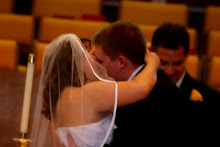
Jess: As our good friends Josh, Sarah, Ben, Kate, and Kelly prepare to move away and leave us youngin's to fend for ourselves at the seminary, Wes and I decided it was time to talk about friends. We've really been thinking about how different our post-college relationships are from the ones that we made at TLU.
After practically living with our friends at TLU over our four years there, moving up here seemed like moving into a void. Our friends were in Texas, and we had no idea how to make new friends up here. Even though we lived in the seminary housing, surrounded by other seminary students, we had a hard time joining the community. This was partially due to moving mid-year, me working 20 minutes away at odd hours of the day, and just general exhaustion from our whirlwind Christmas, wedding, honeymoon, cross-country trip month.
As I worked at Starbucks, I started to make some friends. One of them, Jessica, happened to be a fellow seminary wife from California. Our mutual climate woes, seminary experiences, and Starbucks life made us fast friends, and we hung out from time to time outside of work. She and her husband moved to Iowa last June, though, and although we've kept in contact, that's not quite the same as having friends here. I had other friends from work, but anyone who is friends with their coworkers knows how difficult it is to have both a professional and a social relationship with people--I generally had to choose between the two. I still have some great friends from Sbux, but I've lost contact with most of them in the months since I quit.
Meanwhile, we started regularly attending Prince of Peace, a Lutheran church in nearby Princeton Junction. Our seminary acquaintance, Josh, happened to be one of the interns there, and we started attending Theology on Tap, a Sunday night Bible study with a few people from the church. This is where some of our best NJ friendships have formed. We see these people almost every week, and when we're not having Bible studies, we have parties and get togethers at each other's houses, and just have a good time.
Not long after we started attending this study, we started to hang out with Josh and Sarah outside of school time. All of a sudden, we had friends who wanted to have us over for dinner, play awesome games and just hang out. We've had dinner together almost every month, even after we moved far, far away and now we have to drive to see each other instead of just yelling out of our living room window. Josh and Sarah have been great supporters of our ministry, jobs, school work, etc. They've definitely become an integral part of our lives up here in NJ, and I don't know what we're going to do without them.
All this rambling to say that Wes and I have had to completely rethink our method of making friends. No longer can we count on dinners in Hein, chapel services, class together, etc. to help us make awesome friends. We've had to go outside of our little bubble, invite people over, meet up for dinner or coffee, find common interests, and actually work on building our relationships. And on top of all of that, we have this whole marriage thing to contend with. We have very few single friends up here. Wes has single friends and I have single friends, but we as a couple have very few. It seems so much easier for us to make couple friends as a couple, and work on retaining our individual relationships from Texas. This last year and a half has taught us what it means to be independent adults building friendships.
On a completely different note, I've started a new blog about a project I'm doing this summer. Here you go: http://jesusified.blogspot.com/
Wes: So I like reading blogs. We have a lot of good friends who have a lot of worthwhile things to say, and I like to stay up-to-date on it all. One of blogs that I read is by my pastor's wife, Kim Barnett. Although I've only gotten to hang out with Kim a couple times, I feel like I've gotten to know her well by journeying through life with her in her blog. She and Ryan just got back from a three-month mission excursion in Rwanda, and they were both great at sharing on a regular basis what was going on in their lives while over there. In her blog a few weeks' ago, she made the comment that every married couple should spend three months in a foreign country where neither speak the language because it helps you grow closer together as a couple and learn to depend on each other.
I would add to her statement that moving to another state where you don't know anyone to attend a seminary where everyone is smarter than you can do that same thing. Jess and I were flung into a world that, though it seemed so similar on the surface to life at TLU, was completely different than anything we'd known before. There was no safety net for us to fall on. We were by ourselves. And coming in at the semester as we did, there weren't even other couples who were dealing with the same thing we were. Everyone had their group, and we struggled with fitting in to any of them.
I didn't realize until we moved up here how much I depended on my friends and my community for love and support. I didn't realize how much I fed off of and relied upon the interactions with friends and family until those interactions were cut off. It was hard.
Now don't get me wrong. The people at the seminary, at Starbucks, and at Crosswicks and Ellisdale have been wonderful! We've had a great time and met some amazing people. But the setting, the atmosphere, and the environment are so different than anything I've dealt with before. Most of the people at seminary, with the exception of a handful (and most of them are leaving today or within a month), are fellow students, classmates, and our relationships don't get much deeper than that. Since I'm a pastor now, I've also had to learn the definition of what a church friend is. I can be close to my parishioners, but some lines cannot and should not be crossed with them.
I guess what we're saying is that being an adult can kinda suck. We've lucked out in that we've made some connections up here with some amazing people, but friendship takes a lot more work than it does when you not only have class every week with someone but you also live in the same building, eat at the same places, etc... I understand why my parents cherished the time they could spend with their friends while I took it for granted.
So, for our friends in Texas, New Jersey, and everywhere else on God's green earth, we love you and we thank God for the blessing of having you in our lives. And for everyone in the Princeton/Bordentown area (or really anywhere in New Jersey. Let's face it. This state is tiny!), we have are currently accepting applications for friendship. Resumes must be sent with a cover letter and three non-relative references.
You stay classy, World Wide Web!
Jess and Wes
Monday, June 13, 2011

Monday, June 6, 2011
Patios and Podiums
Jess: Those of you who avidly follow our Facebook accounts probably already know, but Wes and I--along with the fantastic help of some great friends--built a patio this weekend. You may recall from almost a year ago that our backyard was overgrown with not maintained flower gardens and weedy grass:
Well, since it got warm enough to do anything outside, Wes and I have been working to eradicate the terrible lawn problem. When the grass started growing again and we discovered that a large chunk of the lawn was dandelions and other assorted weeds, we sprayed the whole thing with weed killer. Then we did it a couple more times. Now the problem is that we have giant holes in our grass. Our wonderful friends Robert and Lindsey, sufferers of the same fate, described in detail how we can fix this problem over the course of the next year. Luckily for us, between the holly tree, the well and the relative lack of weeds, the front yard almost looks good now.
As for the backyard, we had another solution: cover most of it up, then worry about the last little bit in the fall. So we had our neighbor come over and dig us a nice 10 foot square hole, we ordered a half ton of sand and two tons of rocks, we loaded up 49 patio blocks in our new car (which apparently has amazing suspension), and we called up some friends. Six hours, four new patio blocks, and a lot of hard work later, we have this:


So we spent Memorial Day weekend first building this backyard oasis, and then enjoying it. We had a nice little party on Memorial Day, where we played bocce ball and washers, grilled up some BBQ chicken, and hung out in our fun new backyard. Now it's time to tackle the ivy (which is hopefully not poisonous), the weeds that are attacking my flower beds, and the random plants that are threatening to eat our air conditioner. :-D
Wes: After working tirelessly all weekend on the yard, patio, and fire pit stuff (big shout out and major props to Josh, Sarah, Robert, and Lindsey for their help!), I spent this last week at the Annual Conference of the Greater New Jersey Conference of the United Methodist Church. From Wednesday morning through Saturday late afternoon, over 1200 delegates, comprised of both clergy and lay members of the churches in this area, met to talk about the future of the church and to handle the numerous business issues that were presented by different groups and individuals. This was a voting year, meaning that we had to vote on delegates that would represent our churches and conference at the jurisdictional and general conference levels. I’ve always been intrigued by the voting process, because it is build around the faith the that Holy Spirit will move through the votes of individuals to pick the people that God needs at the other conferences, not the individuals that we want at them. This means that politicking was not allowed. It was very interesting to see the process work and see how the votes would change not because of people making speeches and promises, but because of prayerful discernment about who should go.
I must admit to all of our faithful readers, though, that the politics of the church really get to me at times. When we in the church get to arguing and debating over issues, it makes me sad. So many times this Annual Conference (and the many others I’ve been to), I just wanted to stand up and ask if this was really what Jesus wanted the church to be spending its time doing?! The biggest issue of this conference was the fact that our venue—the King of Prussia Convention Center—is putting in a casino that will inhabit the room above our conference meeting area. The way people were talking about it, you would think that they were afraid that they were going to catch some contagious disease from the “sinners” coming there to gamble. They were talking about breaking contract with the venue, something that would cost the conference hundreds of thousands of dollars, and finding another place to meet within the conference. The funny thing about this, though, is that the only other place that really has enough space and is not too pricey is in Atlantic City, the Vegas of the East Coast! They were talking about picketing the casino entrance, handing out pamphlets to the gamblers, even setting up an in-house protest.
Is this what Christ would have done? Or would he have fellowshipped with the “sinners” that we seem so quick to condemn? How about finding a way to minister to and with the people there without making them feel like we are the holy giving handouts to the wretched?
On a very different note, our keynote speaker for the week was amazing. Mike Slaughter, pastor at Ginghamsburg Church in Dayton, Ohio, really brought it. He was unafraid to call our church leadership—even all the way up to the bishops—out and challenge them to take some time evaluating the way we do “church” to see if it really is effective and life-giving in the world today. I was really moved by his sermons, and I went a little twitter-crazy during them. The first night, I tweeted 74 quotes by him in the span of about an hour, which resulted in facebook disconnecting the twitter app from my profile because I had done too much in too little amount of time. Pretty funny.
The most moving thing that he said, and I could have sworn he was speaking straight to me, was when he said that we in the church—especially clergy—should never vote “no” to something that Jesus would have voted “yes” to. If there is a ministry possibility for you or your church to engage in, don’t let hesitancies, budget constrictions, or lack or resources keep you from doing it. Trust that Jesus will work through it no matter what, and don’t be afraid about the result, because if you are working to bring glory to the Kingdom and show love to God’s people, you can’t fail.
Overall, I’d say it was a great conference. We definitely are a broken people, and a broken people cannot be a perfect institution, but we are striving to do the work of Christ, and I am still proud to call myself a Christian and a member of the United Methodist Church.
Well, that’s all from us. Check in next time for a theological discourse on the economical Trinity.
You stay classy, World Wide Web!
Love,
Jess and Wes

Well, since it got warm enough to do anything outside, Wes and I have been working to eradicate the terrible lawn problem. When the grass started growing again and we discovered that a large chunk of the lawn was dandelions and other assorted weeds, we sprayed the whole thing with weed killer. Then we did it a couple more times. Now the problem is that we have giant holes in our grass. Our wonderful friends Robert and Lindsey, sufferers of the same fate, described in detail how we can fix this problem over the course of the next year. Luckily for us, between the holly tree, the well and the relative lack of weeds, the front yard almost looks good now.
As for the backyard, we had another solution: cover most of it up, then worry about the last little bit in the fall. So we had our neighbor come over and dig us a nice 10 foot square hole, we ordered a half ton of sand and two tons of rocks, we loaded up 49 patio blocks in our new car (which apparently has amazing suspension), and we called up some friends. Six hours, four new patio blocks, and a lot of hard work later, we have this:
So we spent Memorial Day weekend first building this backyard oasis, and then enjoying it. We had a nice little party on Memorial Day, where we played bocce ball and washers, grilled up some BBQ chicken, and hung out in our fun new backyard. Now it's time to tackle the ivy (which is hopefully not poisonous), the weeds that are attacking my flower beds, and the random plants that are threatening to eat our air conditioner. :-D
Wes: After working tirelessly all weekend on the yard, patio, and fire pit stuff (big shout out and major props to Josh, Sarah, Robert, and Lindsey for their help!), I spent this last week at the Annual Conference of the Greater New Jersey Conference of the United Methodist Church. From Wednesday morning through Saturday late afternoon, over 1200 delegates, comprised of both clergy and lay members of the churches in this area, met to talk about the future of the church and to handle the numerous business issues that were presented by different groups and individuals. This was a voting year, meaning that we had to vote on delegates that would represent our churches and conference at the jurisdictional and general conference levels. I’ve always been intrigued by the voting process, because it is build around the faith the that Holy Spirit will move through the votes of individuals to pick the people that God needs at the other conferences, not the individuals that we want at them. This means that politicking was not allowed. It was very interesting to see the process work and see how the votes would change not because of people making speeches and promises, but because of prayerful discernment about who should go.
I must admit to all of our faithful readers, though, that the politics of the church really get to me at times. When we in the church get to arguing and debating over issues, it makes me sad. So many times this Annual Conference (and the many others I’ve been to), I just wanted to stand up and ask if this was really what Jesus wanted the church to be spending its time doing?! The biggest issue of this conference was the fact that our venue—the King of Prussia Convention Center—is putting in a casino that will inhabit the room above our conference meeting area. The way people were talking about it, you would think that they were afraid that they were going to catch some contagious disease from the “sinners” coming there to gamble. They were talking about breaking contract with the venue, something that would cost the conference hundreds of thousands of dollars, and finding another place to meet within the conference. The funny thing about this, though, is that the only other place that really has enough space and is not too pricey is in Atlantic City, the Vegas of the East Coast! They were talking about picketing the casino entrance, handing out pamphlets to the gamblers, even setting up an in-house protest.
Is this what Christ would have done? Or would he have fellowshipped with the “sinners” that we seem so quick to condemn? How about finding a way to minister to and with the people there without making them feel like we are the holy giving handouts to the wretched?
On a very different note, our keynote speaker for the week was amazing. Mike Slaughter, pastor at Ginghamsburg Church in Dayton, Ohio, really brought it. He was unafraid to call our church leadership—even all the way up to the bishops—out and challenge them to take some time evaluating the way we do “church” to see if it really is effective and life-giving in the world today. I was really moved by his sermons, and I went a little twitter-crazy during them. The first night, I tweeted 74 quotes by him in the span of about an hour, which resulted in facebook disconnecting the twitter app from my profile because I had done too much in too little amount of time. Pretty funny.
The most moving thing that he said, and I could have sworn he was speaking straight to me, was when he said that we in the church—especially clergy—should never vote “no” to something that Jesus would have voted “yes” to. If there is a ministry possibility for you or your church to engage in, don’t let hesitancies, budget constrictions, or lack or resources keep you from doing it. Trust that Jesus will work through it no matter what, and don’t be afraid about the result, because if you are working to bring glory to the Kingdom and show love to God’s people, you can’t fail.
Overall, I’d say it was a great conference. We definitely are a broken people, and a broken people cannot be a perfect institution, but we are striving to do the work of Christ, and I am still proud to call myself a Christian and a member of the United Methodist Church.
Well, that’s all from us. Check in next time for a theological discourse on the economical Trinity.
You stay classy, World Wide Web!
Love,
Jess and Wes
Wednesday, May 25, 2011
Donde Esta La Biblioteca?
Jess: Wes decided we need to share the joy of reading with all of our loyal (and not so loyal) blog followers out there on the inter-web. Now that we're both done with class until September, we've been spending quite a lot of our time reading fun books. Our definition of "fun" might be different than yours, but I'm sure you'll enjoy our ramblings anyway. :-D
Recently, I have read:
Blue Like Jazz (Donald Miller)- This is actually the first of three books I am reading by Miller, in a set called Donald Miller Greatest Hits. Wes recommended this book to me, and has been for quite some time, so I guess I needed to read it. The book is about Miller's life--his faith journey, his search to find community, his love life (or lack thereof), etc. The book begins with a short account of Miller's childhood, and his first encounter with true faith. The rest of it goes back and forth between Miller's present interactions and his past--how he met his friends, how he found his church, why he isn't married. It's a difficult book to describe because there isn't really a plotline. It's just Miller's thoughts, beliefs, past, present, and random drawings all mixed together. In the part I just finished, Miller says, "There's not a lot of work in the Christian market if you won't write self-righteous, conservative propaganda. I write new-realism essays. I am not a commodity." That sums this book up better than I could.
I'm not quite done reading this one, so I'm not sure if it's fair for me to judge it or have an opinion yet, but I do, so I'll write about it. This book has been awesome. I've loved reading Miller's work because it's organized like my thoughts are--not well. Each chapter talks about a different subject, bringing in Miller's past, present, friends, family, school, churches, etc. with no regard for a timeline or a purpose. And that's what makes this book great. It's the real story of a real person's unfinished faith journey, and I think that's why it's been so successful. Miller doesn't tell me what to think or believe, but I find myself wondering what his opinion is on certain subjects anyway. He's funny, honest, and fascinating, and I'm excited to read the other two books when I'm not even done with this one yet! Also, who wouldn't love a book with chapter sub-titles like "Living With Freaks," "The Birth of Cool," "Our Tiny Invisible Friends," "The Sexy Carrots," and "Penguin Sex"?
The Search to Belong (Joseph R. Myers)- Wes practically forced this book on me because he read it for his May class and loved it. We owned this book before he took the class, but neither of us had read it (hence my goal to read most, if not all, of the books we own this summer). The main idea of the book is that we all need community, friendships, and belonging, but we need it in four different spaces: public, social, personal, and intimate. We crave relationships in all these spaces, and when one is lacking, we feel unbalanced. Myers then uses this model to explain how congregations can and cannot help people fill these relationship roles. Too often, we try to force people into small groups, aiming for personal or intimate relationships. But these relationships cannot be formed simply on a common life stage or group study. We should not be focusing all of our energy on getting people into "better" relationship situations because all four of these spaces are necessary in our lives and in our faith.
I really liked this book. It was an easy read--it took me about two days of casual reading to get through it. The ideas were simple enough to understand but complex enough to challenge me to take a look at my life and my faith. I would recommend this book to anyone in a leadership position, and pretty much to anyone who wants to take a look at their relationships and our overwhelming desire to be part of something.
The Year of Living Biblically (A.J. Jacobs)- Jacobs is a declared Jew and a practicing agnostic who previously wrote a book while reading the Encyclopedia through in a year. In this new challenge, he decided to follow every single rule in the Bible, beginning with the Torah and eventually using the entire Bible. The book deals with the real-life implications of truly following every command God gives. As Jacobs is performing this experiment, he is also wrestling with difficulty in raising his son, his and his wife's apparent inability to conceive a second time, and his beliefs.
I LOVED reading this book. I think I may have ruined it for Wes if he was planning on reading it soon because I read so many passages out of it. Jacobs is hilarious about the silly things that he does--like when he "stones" a man for being an adulterer, yet brutally honest about his life and his faith. I learned about some laws that I never really noticed before, and spent a good deal of time struggling with my own ideas of faith as well as how I should address this issues. I was impressed by Jacobs' tenacity--he even followed the laws that prevented him from touching his wife, sitting anywhere she had sat, sharing a bed with her, etc. for a week every month. He endured stares, taunts, and general rudeness during his journey, but he definitely learned and taught me a lot in the process.
Recently, I have read:
Blue Like Jazz (Donald Miller)- This is actually the first of three books I am reading by Miller, in a set called Donald Miller Greatest Hits. Wes recommended this book to me, and has been for quite some time, so I guess I needed to read it. The book is about Miller's life--his faith journey, his search to find community, his love life (or lack thereof), etc. The book begins with a short account of Miller's childhood, and his first encounter with true faith. The rest of it goes back and forth between Miller's present interactions and his past--how he met his friends, how he found his church, why he isn't married. It's a difficult book to describe because there isn't really a plotline. It's just Miller's thoughts, beliefs, past, present, and random drawings all mixed together. In the part I just finished, Miller says, "There's not a lot of work in the Christian market if you won't write self-righteous, conservative propaganda. I write new-realism essays. I am not a commodity." That sums this book up better than I could.
I'm not quite done reading this one, so I'm not sure if it's fair for me to judge it or have an opinion yet, but I do, so I'll write about it. This book has been awesome. I've loved reading Miller's work because it's organized like my thoughts are--not well. Each chapter talks about a different subject, bringing in Miller's past, present, friends, family, school, churches, etc. with no regard for a timeline or a purpose. And that's what makes this book great. It's the real story of a real person's unfinished faith journey, and I think that's why it's been so successful. Miller doesn't tell me what to think or believe, but I find myself wondering what his opinion is on certain subjects anyway. He's funny, honest, and fascinating, and I'm excited to read the other two books when I'm not even done with this one yet! Also, who wouldn't love a book with chapter sub-titles like "Living With Freaks," "The Birth of Cool," "Our Tiny Invisible Friends," "The Sexy Carrots," and "Penguin Sex"?
The Search to Belong (Joseph R. Myers)- Wes practically forced this book on me because he read it for his May class and loved it. We owned this book before he took the class, but neither of us had read it (hence my goal to read most, if not all, of the books we own this summer). The main idea of the book is that we all need community, friendships, and belonging, but we need it in four different spaces: public, social, personal, and intimate. We crave relationships in all these spaces, and when one is lacking, we feel unbalanced. Myers then uses this model to explain how congregations can and cannot help people fill these relationship roles. Too often, we try to force people into small groups, aiming for personal or intimate relationships. But these relationships cannot be formed simply on a common life stage or group study. We should not be focusing all of our energy on getting people into "better" relationship situations because all four of these spaces are necessary in our lives and in our faith.
I really liked this book. It was an easy read--it took me about two days of casual reading to get through it. The ideas were simple enough to understand but complex enough to challenge me to take a look at my life and my faith. I would recommend this book to anyone in a leadership position, and pretty much to anyone who wants to take a look at their relationships and our overwhelming desire to be part of something.
The Year of Living Biblically (A.J. Jacobs)- Jacobs is a declared Jew and a practicing agnostic who previously wrote a book while reading the Encyclopedia through in a year. In this new challenge, he decided to follow every single rule in the Bible, beginning with the Torah and eventually using the entire Bible. The book deals with the real-life implications of truly following every command God gives. As Jacobs is performing this experiment, he is also wrestling with difficulty in raising his son, his and his wife's apparent inability to conceive a second time, and his beliefs.
I LOVED reading this book. I think I may have ruined it for Wes if he was planning on reading it soon because I read so many passages out of it. Jacobs is hilarious about the silly things that he does--like when he "stones" a man for being an adulterer, yet brutally honest about his life and his faith. I learned about some laws that I never really noticed before, and spent a good deal of time struggling with my own ideas of faith as well as how I should address this issues. I was impressed by Jacobs' tenacity--he even followed the laws that prevented him from touching his wife, sitting anywhere she had sat, sharing a bed with her, etc. for a week every month. He endured stares, taunts, and general rudeness during his journey, but he definitely learned and taught me a lot in the process.
Wes: Can anyone name the movie that the title of this blog post quotes? Ten stars and a golden panda for anyone who can correctly ascertain the answer.
Before I get in to the books that I've been reading, I wanted to share with the world that as off June, I will be the appointed local pastor to Crosswicks UMC and Ellisdale UMC. Now, since these are the churches that I've already been working at, this is not a move, but a promotion of sorts. For the past year, I've been working as the supply pastor for the two churches--I run the ministry, head the meetings, and everything else a regular pastor does, but I have not have sacramental rights and have had to have a retired elder, Pastor Franz, come in once a month to do communion for us. Now, though, I will be able to preside over communion and baptisms at my churches and do not have to have Pastor Franz drop in every month. Even though I have loved the opportunity to work with Rev. Franz, I am very excited about this transition. Being appointed also means that I am no longer a "hired" worker at the churches. This adds to my job security a little, which is always nice.
So. Books. I, too, read The Search to Belong and I, too, loved it. It is a great book to read for anyone serving in any capacity of church leadership, because it really makes one think about the ways in which the church invites. urges, and sometimes tries to force belonging. The writer gives a wonderful breakdown of the different types of relationships that people engage in (as Jess spoke of above) and relates these to different ministry offerings and opportunities. For him, a healthy church is one that offers a number of different ministries in each space, just as a healthy person is one that engages in a number of different relationships in each space.
The only thing that Jess and I had as a critique was that we think there should be a fifth category, larger than public: Facebook Friends. This book, written in 2003, was based on a world that was just being introduced to social media. Now, I might have a couple people in an intimate relational space, a handful in personal, a good group in social, and a large group in public and still have hundreds of Facebook friends who don't fit in any category. And yet some would say they belong to certain people because of their link with social media. We need to realize the need for ministry at this level too, even if it looks strange to many people.
I just finished reading The Monkey and The Fish, a book about Third-Culture Churches and what it means to have liquid leadership in churches today. I thoroughly enjoyed this book, because it challenged church leaders to discern the ministry needs in their community and to engage them with the majority of their time and energy. The most influential line of the book was when the author, Dave Gibbons, asks why we as a church focus so much of our energy on Sunday mornings and turn our backs on the rest of the week. Even my home church, University, that is so good about doing different types of ministries throughout the week, devotes more effort to that Sunday service time than anything else. Quite a lot more. I do not think this is bad, but I do think that each individual church (and the leaders therein) must discern whether or not the priorities of the church are what they should be, or what they've always been. As Gibbons says, the church must be ready and able to mold itself to the needs of the culture around it. Just as the world needed the Word to become flesh in order that humanity might be saved, the world needs the church to be different things at different times in order that humanity might come face to face with God.
Now, I'm re-reading Ragamuffin Gospel, by Brennan Manning, one of my favorite books of all time. I'll talk more about this when I'm further in, because it's so quotable, I want to make sure that I do it justice and pull the right parts of it out. I'm sure that if you follow my twitter account, you'll easily see about a hundred quotations from this books posted in the next week or so.
Finally, I am currently in search of a new devotional book. I have been using My Utmost for His Highest, by Oswald Chambers. This is a great book, and some of what he says really hits home, but I find myself pushing back against a lot of what he says in this and a lot of his theology, so I would like to find something else to use for my daily reading. I'm not against reading things I don't agree with, but especially since I've been doing my devotional in the morning as a way to greet the day and greet my God, I'd rather something I can dive into without wanting to engage in a lively theological conversation. Any suggestions you have would be swell.
Well, that's all for now! Come back next week for an in-depth investigation into the doctrine of the hyperstatic union of the Godhead (or whatever Jess decides it is we're writing about). Until then, you stay classy, World Wide Web!
-Jess and Wes
Thursday, May 19, 2011
Summer Fun
Jess: First off, I'd like to say that Wes and I just bought a new car, and we managed to put over 50% down. I'll let Wes tell you about it and post a pic or two, but we're pretty excited.
Wes suggested that we write about our summer plans because, much like the rest of our lives, we are doing a lot in a short period of time. During the month of June, I'm going to be babysitting pretty much full time, especially after the kids get done with school. My main family is going to need me every day for most of the day, and I'm still helping two other families. In July and August, they're going to be on vacation at their beach house and in England, so I'll be babysitting part-time for my other two families. I have an interview on Saturday for another summer job, because I honestly don't know what I'll do with myself if I'm only working part-time. Sure, I have a goal to read all of the books in our personal library, but there's only so much sitting and reading one can do.
I'll be starting school in the fall, so a lot of my summer is going to be dedicated to making a good schedule for the fall so I can juggle 2 classes per week, work in the afternoons, some field education, and the whole being the pastor's wife thing. My goal is to make sure I have Saturdays off, because I need a day each week when I don't have to get up and get going and to get work done around the house. I also have to figure out how I'm going to do seminary, exactly, so that should be fun times.
We're going to use most of our spare time throughout the summer to keep working on the house. Our first project is to build a patio next weekend. We want to have a nice place to sit and hang out outside, so we're getting this done before it gets too hot. We have a perfectly shaded spot, which is not too far from project 2: making a fire pit. We're also going to be doing some cleaning projects, some painting, changing out some lights, and our next major project: putting wood flooring in the kitchen. It's time to update our kitchen and bathrooms for the 21st century. Our house is great, but there's definitely lots that can be done to improve it.
Let's see...we're also going to my mom's wedding in June. I'm the matron of honor and Wes is going to be preaching at the service. I'm excited to see a bunch of my family, some of whom I haven't seen in a long time. And we're absolutely happy for my mom! Sometime in late July/early August, Wes' mom and sister are coming to visit us and use my babysitting family's beach house. Yay for the Jersey Shore!
Wes suggested that we write about our summer plans because, much like the rest of our lives, we are doing a lot in a short period of time. During the month of June, I'm going to be babysitting pretty much full time, especially after the kids get done with school. My main family is going to need me every day for most of the day, and I'm still helping two other families. In July and August, they're going to be on vacation at their beach house and in England, so I'll be babysitting part-time for my other two families. I have an interview on Saturday for another summer job, because I honestly don't know what I'll do with myself if I'm only working part-time. Sure, I have a goal to read all of the books in our personal library, but there's only so much sitting and reading one can do.
I'll be starting school in the fall, so a lot of my summer is going to be dedicated to making a good schedule for the fall so I can juggle 2 classes per week, work in the afternoons, some field education, and the whole being the pastor's wife thing. My goal is to make sure I have Saturdays off, because I need a day each week when I don't have to get up and get going and to get work done around the house. I also have to figure out how I'm going to do seminary, exactly, so that should be fun times.
We're going to use most of our spare time throughout the summer to keep working on the house. Our first project is to build a patio next weekend. We want to have a nice place to sit and hang out outside, so we're getting this done before it gets too hot. We have a perfectly shaded spot, which is not too far from project 2: making a fire pit. We're also going to be doing some cleaning projects, some painting, changing out some lights, and our next major project: putting wood flooring in the kitchen. It's time to update our kitchen and bathrooms for the 21st century. Our house is great, but there's definitely lots that can be done to improve it.
Let's see...we're also going to my mom's wedding in June. I'm the matron of honor and Wes is going to be preaching at the service. I'm excited to see a bunch of my family, some of whom I haven't seen in a long time. And we're absolutely happy for my mom! Sometime in late July/early August, Wes' mom and sister are coming to visit us and use my babysitting family's beach house. Yay for the Jersey Shore!
Wes: First, a pic of the car:

So unlike Jess, I don't get to sit around the house all day doing nothing this summer. Some of us have to work, have to earn a living, have to bring home the bacon, have to keep a roof over the family's head, etc...
I wanted to start by saying that I just finished a short-term intensive class on Evangelism in the Congregation, and I must say that after this class, I am at the same time frustrated about what I've been doing wrong and excited about what I can now do right when it comes to evangelism. My biggest take home from this class was the idea that evangelism should always be about sharing the Good News, something we tend to replace with bad news. Evangelism is not going up to someone and saying "Hi! My name is Wes, and you're going to hell." Too many times we place priority on the proclamation of sinfulness and hell, taking a fear-based technique. But this is not Good News. The Good News message is that God loves us so much that God did everything necessary--even to the point of dying on a cross--for us to be able to be in fellowship with Him. We as evangelists (something that everyone is called to) must lift this up.
I'm going to be continuing at the churches here in Crosswicks and Ellisdale, and I'm very excited about what the next few months hold. I received word earlier this week that I will be receiving my local pastor's license by the end of June, which means that I'll be able to preside over Holy Communion and any baptisms at my churches. I've been very grateful that Rev. Horace Franz has been gracious enough to come and handle the Eucharist at the churches once a month, but I am looking forward to being able to do it myself now. This also means that we can transition from only doing Communion once a month to doing it every week, which is my preferred method. The parishes within the United Methodist Church usually only do Communion monthly, a tradition that goes back to the circuit-riding times when a preacher might have up to 10 churches on his circuit, only seeing each one every month or so. Monthly communion was a necessity, because that was the only time the preacher was present. Now, though, we are able to do it weekly, so I say, why the heck not?
I'm also excited about a sermon series we will be going through starting on June the 26th. Both congregations will be reading through The Story, a novel published by Zondervan that goes through the entire biblical narrative in 31 chapters. It's a great way to get people reading the Bible and get them used to the biblical stories. So, every week for 31 weeks we will be going over a chapter in the book. Then, by next Spring (we're taking a break in December for Advent), we will have gone through the entire biblical narrative as a church. I'm excited about it and excited to get to preach on random books like Ezra and Nehemiah. Super fun stuff.
I'm also going to be working part-time at the Albert C Wagner Youth Correctional Facility as a prison chaplain. Princeton Seminary requires two different field education sites--one year-long and one summer-long. I am using my churches as my year-long site, but I needed one for this summer that would leave my Sundays open for church work. So, I am very excited to work with Rev. Bourjolly, the full-time prison chaplain, and learn about an aspect of ministry that I have never engaged before. Hopefully, this will allow me to see sides of my calling that I had not pursued, and hopefully I will be able to touch lives for Christ while I am there.
I am also excited about the conference-level opportunities God has given me this summer. I am going to be the speaker at a summer camp the first part of August, and I am pumped about sharing that time with the students. I first answered my call to ministry at a summer camp, and it was through the ways God worked in people there that I was able to do so. People like Ryan Barnett, Rusty Freeman, Matt Pennington, and so many more were influential in me becoming the person I am today (yeah, it's their faults). I hope God will use me as an influence for others at this camp.
Well, that's about all that's going down with us! What are your summer plans?
You stay classy, World Wide Web!
-Jess and Wes
Monday, May 16, 2011
The Top Ten Reasons You Shouldn't Get Married--REPOSTED DUE TO BLOGGER'S MISTAKES!
Jess and Wes: Just kidding. We decided it was about time for us to have a fun, sing-a-long blog. Well, you can try to sing-a-long, at least. We've been kind of heavy on the theology/difficult life situations aspect recently, so we're just going to write a list of the top ten things we've learned since getting married. Some will be funny, some will be true, some will be both funny and true.
So here's our marriage list:
1. Wes and I have VERY different ideas about what is "clean enough." We have worked out a good system, though: Wes makes a mess until I can't stand it, and then I move all of the piles of stuff into his office and close the door.
2. Sharing is caring--it's also much more difficult than it sounds. Wes and I have been sharing not only a house, responsibilities, movie choices, etc., but a car for almost a year and a half now. I think it's actually become easier as time goes on, but, more importantly, it's taught us about respecting the other person's time and needs. I'm excited that we'll be free of this occasional burden by the end of the month, but I'm actually going to miss the "forced" time together and recognizing that sometimes it's okay to get up and leave two hours early to share a 30 minute commute with your spouse.
3. Keeping an extra blanket at the foot of the bed is a necessity when your wife is a registered covers hog. Keeping a tight grip on your pillow throughout the night is a necessity when your husband has been known to steal said pillows and deposit them on the other side of the room while sleep walking.
4. "What's mine is yours" only applies to the man. "What's mine is mine AND what's yours is mine" is what women say. :-D
5. Being married doesn't change everything. Yes, we spend a ton of time together, share a home, etc., but that doesn't change the fact that we like to hold hands, joke around, and just act like we've only been dating for a couple of weeks. And that's awesome.
6. Money is lame. Sharing money doesn't make it any less lame.
7. Play fighting is fun, but you have to make sure that bystanders are not in listening or seeing distance (AKA repairmen, waiters, etc...). They might think that your threatening to stab your partner is in fact valid.
8. There is a limit to how much two-player Mario and Donkey Kong can be played before one or both of you end up throwing a controller across the room while saying very un-pastorly things.
9. Allowing your husband to tell houseguests that "naked Tuesday" is mandatory may make everyone uncomfortable...especially since "naked Tuesday" doesn't exist. Is there some machine that lets me know what he's thinking before he says it?
10. Marriage is better than we had expected. Yes, it takes work, but it is absolutely wonderful--a definite blessing from God.
So here's our marriage list:
1. Wes and I have VERY different ideas about what is "clean enough." We have worked out a good system, though: Wes makes a mess until I can't stand it, and then I move all of the piles of stuff into his office and close the door.
2. Sharing is caring--it's also much more difficult than it sounds. Wes and I have been sharing not only a house, responsibilities, movie choices, etc., but a car for almost a year and a half now. I think it's actually become easier as time goes on, but, more importantly, it's taught us about respecting the other person's time and needs. I'm excited that we'll be free of this occasional burden by the end of the month, but I'm actually going to miss the "forced" time together and recognizing that sometimes it's okay to get up and leave two hours early to share a 30 minute commute with your spouse.
3. Keeping an extra blanket at the foot of the bed is a necessity when your wife is a registered covers hog. Keeping a tight grip on your pillow throughout the night is a necessity when your husband has been known to steal said pillows and deposit them on the other side of the room while sleep walking.
4. "What's mine is yours" only applies to the man. "What's mine is mine AND what's yours is mine" is what women say. :-D
5. Being married doesn't change everything. Yes, we spend a ton of time together, share a home, etc., but that doesn't change the fact that we like to hold hands, joke around, and just act like we've only been dating for a couple of weeks. And that's awesome.
6. Money is lame. Sharing money doesn't make it any less lame.
7. Play fighting is fun, but you have to make sure that bystanders are not in listening or seeing distance (AKA repairmen, waiters, etc...). They might think that your threatening to stab your partner is in fact valid.
8. There is a limit to how much two-player Mario and Donkey Kong can be played before one or both of you end up throwing a controller across the room while saying very un-pastorly things.
9. Allowing your husband to tell houseguests that "naked Tuesday" is mandatory may make everyone uncomfortable...especially since "naked Tuesday" doesn't exist. Is there some machine that lets me know what he's thinking before he says it?
10. Marriage is better than we had expected. Yes, it takes work, but it is absolutely wonderful--a definite blessing from God.
Monday, May 2, 2011
Since everyone else is doing it...
Jess: Wes was practically begged by one of our friends (who shall remain unnamed) to write this post today. So here goes.
Bin Laden is dead. Okay. That's one more person who has died in this war of almost 10 years. Yes, he did some really, really awful stuff. Yes, thousands of people in our country have died because of the stuff he did. Yet Christians are called to love one another. If I'm not mistaken, "love" is one of the most common words in the Bible. Jesus says, "If you love those who love you, what credit is that to you? Even ‘sinners’ love those who love them. And if you do good to those who are good to you, what credit is that to you? Even ‘sinners’ do that." (Luke 6:32-33). We are called to love one another, good or bad, nice or mean, friend or enemy. That means that when someone dies, we should mourn.
Again, I realize that Bin Laden was a evil man. His thoughts and actions prompted many more people to think, say, and do evil things. But if we respond to his death with celebrations in the street, Facebook and Twitter posts about how awesome America is, and happiness, then we are just more of the people who have thought, said, and done evil things because of Bin Laden. I know it's an overused Bible passage, but Jesus told us to turn the other cheek. Yes, as Dr. Ruge-Jones taught many of us TLU-ers, there is a message of passive resistance in that verse. But the main point in the message is that we are not to exchange stealing for stealing, cruelty for cruelty, or violence for violence. We are called to be peacemakers, not killers.
There are some who say that Christians are called to fight evil, that there are passages in the Bible that prove this. But Jesus never commanded violence; he came not to fight against oppression, not to overthrow the Romans, but to die for all of us sinful humans. Bin Laden is definitely one of those sinful humans--he's up there with Hitler on a lot of people's lists. But I am just as sinful. So are you. Yes, I've never killed anyone. I've never plotted the murder and destruction of people just because of their nationality. Again, Jesus says that my division of sins into "worse" or "not quite so bad" just isn't the way it works: “You have heard that it was said to the people long ago, ‘Do not murder, and anyone who murders will be subject to judgment.’ But I tell you that anyone who is angry with his brother will be subject to judgment."
So my anger with my (real or spiritual) brother is just as bad as Bin Laden's murder. That's a tough pill to take. It doesn't make sense to us. Yet it doesn't need to make sense to us. Our law is not the same as God's law. I completely agree that we need laws to keep the world from falling into chaos. We're not perfect, so we need worldly laws as well as God's. But we absolutely MUST realize that they are not the same. In the same way, God's punishments do not mesh with ours (see our last blog post about Rob Bell for more on this).
My main thought all day today has been disappointment. Am I disappointed that Bin Laden is dead? Not particularly. Am I disappointed in myself for thinking that way? Absolutely. And I'm disappointed that I can't see any other news on Yahoo--what about our brothers and sisters who are being ravaged by tornadoes? What about Syria? What about...anything else? I'm disappointed that my favorite radio station has played almost nothing but "America is awesome" songs all day long, mixing in quotations from Obama's speech last night. I'm sad that people are dancing in the streets. A human being is dead. And that should make us all sad.
Wes: Well, as always, Jess said pretty much everything that needed to be said. Which doesn't leave me with much to talk about. I'll take a swing at filling in a few of the gaps that she so graciously left for me.
I am not one of those people who wakes up every morning and turns on the news or reads a newspaper. I wish that I was. I really do. By the time I'm awake enough to formulate coherent thoughts, though, I'm usually halfway through with my drive to school. So my newsmongering usually comes later in the day, when I jump onto a few online news sites and see what's what in the world today. Therefore, I did not know about bin Ladin until one of my friends texted me about it while I was in class. I waited impatiently for my break and then jumped on the news to see what the heck was going on.
My first impression after receiving a text saying he'd been captured: Great. We caught one of the top leaders of a militant, fundamentalist, extremist group that had taken credit for a large number of terrorist attacks around the world. For a country that needs a morale boost, this is exactly what we needed.
Then I read that he had been killed. Then I read that people were celebrating in the streets of NYC, on the Washington DC Mall, and throughout the world. Not celebrating that he had been captured, but that the sorry so-and-so had been killed. We were cheering, singing, shouting for joy over the death of person.
Someone on a news article likened it to the way certain extremists celebrated in the Middle East after the planes crashed into the World Trade Center buildings and into the Pentagon.
Celebrating. Really?
Then I jumped on my facebook and started seeing posts from my different friends. I saw the expected satirical commentary from a few people (shout out to Corbin!!!), which I only expected because I know that they are some of the deepest thinking people I know and they could truly balance the truth and the satire. I saw some Bible verses of hope and love from others. And then I saw a long string of hateful remarks, mis-used Scripture, and more celebration from a number of my friends.
Most of them either spiritual leaders--pastors and youth pastors--or strong leaders within their faith communities.
I didn't know what to think. I didn't know what to say. I was disappointed in my fellow brothers and sisters. I was hurt that they were inserting God's hand of justice into an act of killing.
I kept thinking of this quotation from Dr. Martin Luther King Jr.:
"I will mourn the loss of thousands of precious lives, but I will not rejoice in the death of one, not even an enemy. Returning hate for hate multiplies hate, adding deeper darkness to a night already devoid of stars. Darkness cannot drive out darkness: only light can do that. Hate cannot drive out hate, only love can do that."
So I posted it. One of my good friends, a man I look up to greatly, mentioned that I was speaking from a place of privalege. I've always been an outsider looking in on most of the injustices of the world. I have the luxury of living on the other side of the battles, of the war, of the death of bin Ladin. And he's right. I do. I've never had to see the hatred in the eyes of a man that believes completely that I am evil and I have a God-ordained death sentence. I've never had to suffer through the horrors of war like so many have. I've never known life outside of my privalege.
But if people like Dr. King can say this, if people like Gandhi (spoiler alert: not even a Christian!) can uphold a lifestyle of love in the midst of terrible, horrific oppression, I would hope that people like myself could do so as well. We as Christians are called to uplift justice, but never to rejoice in the loss of life. It might be a thin line at times, but the line is there.
I rejoice in justice. I do. But I do not rejoice in the loss of a life, even the life of Osama bin Ladin. I hope that God has more grace and compassion for him than we do. For I whole-heartedly admit that he deserves death, but so do I.
One of Jess' and my friends from TLU make an amazingly spot-on comment about how a week ago, we were celebrating Easter, celebrating life and the victory of God's love over death's power. Now we are celebrating death.
Not much different than those who shouted "Hosanna" one day and "Crucify" soon after...
May love, now and always, win.
Next blog will be light-hearted. I promise. For now, you stay classy, World Wide Web.
-Jess and Wes
Bin Laden is dead. Okay. That's one more person who has died in this war of almost 10 years. Yes, he did some really, really awful stuff. Yes, thousands of people in our country have died because of the stuff he did. Yet Christians are called to love one another. If I'm not mistaken, "love" is one of the most common words in the Bible. Jesus says, "If you love those who love you, what credit is that to you? Even ‘sinners’ love those who love them. And if you do good to those who are good to you, what credit is that to you? Even ‘sinners’ do that." (Luke 6:32-33). We are called to love one another, good or bad, nice or mean, friend or enemy. That means that when someone dies, we should mourn.
Again, I realize that Bin Laden was a evil man. His thoughts and actions prompted many more people to think, say, and do evil things. But if we respond to his death with celebrations in the street, Facebook and Twitter posts about how awesome America is, and happiness, then we are just more of the people who have thought, said, and done evil things because of Bin Laden. I know it's an overused Bible passage, but Jesus told us to turn the other cheek. Yes, as Dr. Ruge-Jones taught many of us TLU-ers, there is a message of passive resistance in that verse. But the main point in the message is that we are not to exchange stealing for stealing, cruelty for cruelty, or violence for violence. We are called to be peacemakers, not killers.
There are some who say that Christians are called to fight evil, that there are passages in the Bible that prove this. But Jesus never commanded violence; he came not to fight against oppression, not to overthrow the Romans, but to die for all of us sinful humans. Bin Laden is definitely one of those sinful humans--he's up there with Hitler on a lot of people's lists. But I am just as sinful. So are you. Yes, I've never killed anyone. I've never plotted the murder and destruction of people just because of their nationality. Again, Jesus says that my division of sins into "worse" or "not quite so bad" just isn't the way it works: “You have heard that it was said to the people long ago, ‘Do not murder, and anyone who murders will be subject to judgment.’ But I tell you that anyone who is angry with his brother will be subject to judgment."
So my anger with my (real or spiritual) brother is just as bad as Bin Laden's murder. That's a tough pill to take. It doesn't make sense to us. Yet it doesn't need to make sense to us. Our law is not the same as God's law. I completely agree that we need laws to keep the world from falling into chaos. We're not perfect, so we need worldly laws as well as God's. But we absolutely MUST realize that they are not the same. In the same way, God's punishments do not mesh with ours (see our last blog post about Rob Bell for more on this).
My main thought all day today has been disappointment. Am I disappointed that Bin Laden is dead? Not particularly. Am I disappointed in myself for thinking that way? Absolutely. And I'm disappointed that I can't see any other news on Yahoo--what about our brothers and sisters who are being ravaged by tornadoes? What about Syria? What about...anything else? I'm disappointed that my favorite radio station has played almost nothing but "America is awesome" songs all day long, mixing in quotations from Obama's speech last night. I'm sad that people are dancing in the streets. A human being is dead. And that should make us all sad.
Wes: Well, as always, Jess said pretty much everything that needed to be said. Which doesn't leave me with much to talk about. I'll take a swing at filling in a few of the gaps that she so graciously left for me.
I am not one of those people who wakes up every morning and turns on the news or reads a newspaper. I wish that I was. I really do. By the time I'm awake enough to formulate coherent thoughts, though, I'm usually halfway through with my drive to school. So my newsmongering usually comes later in the day, when I jump onto a few online news sites and see what's what in the world today. Therefore, I did not know about bin Ladin until one of my friends texted me about it while I was in class. I waited impatiently for my break and then jumped on the news to see what the heck was going on.
My first impression after receiving a text saying he'd been captured: Great. We caught one of the top leaders of a militant, fundamentalist, extremist group that had taken credit for a large number of terrorist attacks around the world. For a country that needs a morale boost, this is exactly what we needed.
Then I read that he had been killed. Then I read that people were celebrating in the streets of NYC, on the Washington DC Mall, and throughout the world. Not celebrating that he had been captured, but that the sorry so-and-so had been killed. We were cheering, singing, shouting for joy over the death of person.
Someone on a news article likened it to the way certain extremists celebrated in the Middle East after the planes crashed into the World Trade Center buildings and into the Pentagon.
Celebrating. Really?
Then I jumped on my facebook and started seeing posts from my different friends. I saw the expected satirical commentary from a few people (shout out to Corbin!!!), which I only expected because I know that they are some of the deepest thinking people I know and they could truly balance the truth and the satire. I saw some Bible verses of hope and love from others. And then I saw a long string of hateful remarks, mis-used Scripture, and more celebration from a number of my friends.
Most of them either spiritual leaders--pastors and youth pastors--or strong leaders within their faith communities.
I didn't know what to think. I didn't know what to say. I was disappointed in my fellow brothers and sisters. I was hurt that they were inserting God's hand of justice into an act of killing.
I kept thinking of this quotation from Dr. Martin Luther King Jr.:
"I will mourn the loss of thousands of precious lives, but I will not rejoice in the death of one, not even an enemy. Returning hate for hate multiplies hate, adding deeper darkness to a night already devoid of stars. Darkness cannot drive out darkness: only light can do that. Hate cannot drive out hate, only love can do that."
So I posted it. One of my good friends, a man I look up to greatly, mentioned that I was speaking from a place of privalege. I've always been an outsider looking in on most of the injustices of the world. I have the luxury of living on the other side of the battles, of the war, of the death of bin Ladin. And he's right. I do. I've never had to see the hatred in the eyes of a man that believes completely that I am evil and I have a God-ordained death sentence. I've never had to suffer through the horrors of war like so many have. I've never known life outside of my privalege.
But if people like Dr. King can say this, if people like Gandhi (spoiler alert: not even a Christian!) can uphold a lifestyle of love in the midst of terrible, horrific oppression, I would hope that people like myself could do so as well. We as Christians are called to uplift justice, but never to rejoice in the loss of life. It might be a thin line at times, but the line is there.
I rejoice in justice. I do. But I do not rejoice in the loss of a life, even the life of Osama bin Ladin. I hope that God has more grace and compassion for him than we do. For I whole-heartedly admit that he deserves death, but so do I.
One of Jess' and my friends from TLU make an amazingly spot-on comment about how a week ago, we were celebrating Easter, celebrating life and the victory of God's love over death's power. Now we are celebrating death.
Not much different than those who shouted "Hosanna" one day and "Crucify" soon after...
May love, now and always, win.
Next blog will be light-hearted. I promise. For now, you stay classy, World Wide Web.
-Jess and Wes
---UPDATE---
The above quotation from Dr. Martin Luther King Jr. is not correct. Due to a crazy Facebook sensation that started with some American woman teaching elementary school in Japan, the quotation was amended. I apologize for the mis-quote, but would like to offer the correct quotation below:
"Returning hate for hate multiplies hate, adding deeper darkness to a night already devoid of stars. Darkness cannot drive out darkness; only light can do that. Hate cannot drive out hate, only love can do that."
Another great quotation from the late Dr. King is the following:
"The ultimate weakness of violence is that it is a descending spiral, begetting the very thing it seeks to destroy. Instead of diminishing evil, it multiplies it. Through violence you may murder the liar, but you cannot murder the lie, norestablish the truth. Through violence you may murder the hater, but you do not murder hate. In fact, violence merely increases hate. So it goes. Returning violence for violence multiplies violence, adding deeper darkness to a night already devoid of stars. Darkness cannot drive out darkness; only light can do that. Hate cannot drive out hate: only love can do that." - MLK, Where Do We Go from Here: Chaos or Community?, pp. 62–63 (1967)
Tuesday, April 26, 2011
Controversy!
Jess: I hope everyone read the title of this entry in a sing-song Peter Griffin voice. If you didn't, please go back and read it again before moving on. This is extremely important to me...
Alright, so now it's time for Wes and I to tackle Rob Bell's new book, Love Wins. If you haven't heard about this book, I don't know where you've been. Bell's video promo of the book led to him being attacked as a heretic, not a Christian, and basically just a bad guy. He's been on Good Morning America, the cover of Time Magazine, and I don't even know what else since the publication of this book. And that's ignoring the internet (is that even possible?). Here's Bell's 2.5 minute introduction to the book.
Anyway, this book should be in no way shocking to any well-trained, intelligent pastor; it shouldn't even be that crazy for most Christians who have seriously considered their beliefs and have more than just a "blind" faith. Whether or not you believe in it is (for this paragraph, at least), irrelevant. The book's ideas should not shock you if you have spent your Christian life wondering who God is and what God does. Bell himself says, "...nothing in this book hasn't been taught, suggested, or celebrated by many before me." Yet he is being called a heretic on a daily basis. People are insisting that Rob Bell can't possibly be correct. Pastors are being fired for saying that Bell isn't necessarily wrong.
My biggest problem with this book isn't the book at all. I think it's well-written; Bell bases his argument in Scripture, history, and both past and current theologies. The points are fairly complex, yet he presents them in everyday, easy to understand language. A child could pick up this book and understand most of it. Yet what Bell says is tearing Christians apart--but doesn't everything? That's my problem. Wes and I have talked about this before: we're Christians. We're called to love God and love our neighbors. But how can we do this when we attack our neighbors for having opinions? For highlighting the many possibilities that God's love brings?
When we put God in a box, when we define who God is and what God can or can't do, that's when we're making our biggest mistake. I don't care if you agree or disagree with my belief that the prevailing message of God's actions throughout history is love. What I do care about is how you react through your agreement or disagreement. If you can sit down and have a conversation with me about the topic, great. If you sit me down and tell me I'm wrong and you're right, and that I'm going to hell because of my beliefs...not great. We as Christians are called to "make disciples of all nations." How can we do that if we're driving people away from Jesus? One of the greatest points Bell makes isn't about heaven or hell at all--it's that Christians are killing Christianity. We like to tell people what is and isn't true about Jesus, and for that reason, "Some people have so much baggage with regard to the name 'Jesus' that when they encounter the mystery present in all of creation-- grace, peace, love, acceptance, healing, forgiveness--the last thing they are inclined to name it is 'Jesus'"
So are we destroying the real, loving, saving Jesus through our constant need to tell people who and what God through Jesus is? I think so. I admire Rob Bell for his strength to put his name on this book. Many "Christians" today want to know that being a Christian is about going to church on Sunday, then going home and living just like they did before the Sunday service. Or they want to know that being a Christian is about telling other people their beliefs are wrong. But they don't want to hear that being a Christian being like Christ. Heaven forbid.
I have a hard time believing in a God who would lovingly send his son to die for the sake of all humanity, yet let most of those same humans spend an eternity in hell for the same sins. But I haven't yet come to terms with the possibility of God letting just anyone into heaven. It's a tough thing to accept. If God is loving enough to let me, a sinner, into heaven, then that means that God is loving enough to let let the people who made my life a living hell in junior high into heaven. Then God is loving enough to my neighbor who has never gone to church and has rejected God all her life into heaven. And that means that God is loving enough to let Hitler into heaven.
That's a lot to handle. But if Hitler sinned "too much" to get into heaven, where's the line? What if I commit one sin too many in my life? I hope that God is loving enough to accept Hitler into heaven, because that means God is loving enough to accept me.
Wes: So it seems like everyone is writing about this issue. Why not us as well? But, I must admit that no post of ours will ever hit the spot like Donald Miller's did. If you haven't read it, check it out!
Anyways, here's the deal. I've been struggling with the question of Heaven and Hell for years. The more I read Holy Scripture, and the more I grow in faith, the more I struggle with the notion of there being a place beyond death that is completely devoid of God's love. The more time I spend in worship of the Almighty, and the more I come to understand His love and mercy, the more I struggle with the idea that there is a place where God refuses to go, a depth that God refuses to dive, a realm where God refuses to give yet another chance of redemption to one of His creation. This does not compute for me. How can God be all loving and all powerful and still send people to Hell? Even more disheartening for me is this: How can God be all loving and all powerful and not allow redemption even for those in Hell?
This question started nagging on me when I was asked by a young man in my youth group whether or not God would ever forgive and redeem the devil if Satan repented. My by-rote answer was that God had condemned Satan to Hell for blaspheming and trying to usurp God, something that is unforgivable. But I started thinking over this and realized that I don't know if I believe that. Is the chasm between God and Hell so vast that His love cannot bridge it? One can always respond with something like, "Well Satan would never repent, so it doesn't matter."
Satan might not, I don't know. But I am sure that, given the opportunity, there's gotta be at least one person confined to Hades who would repent if given the chance. Would God really deny them the opportunity to receive His grace? Are we so bold as to claim a limit on God's love, even a limit so vast as Hell?
"Who shall separate us from the love of Christ? Shall trouble or hardship or persecution or famine or nakedness or danger or sword? As it is written: 'For your sake we face death all day long; we are considered as sheep to be slaughtered.' No, in all these things we are more than conquerors through him who loved us. For I am convinced that neither death nor life, neither angels nor demons, neither the present nor the future, nor any powers, neither height nor depth, nor anything else in all creation, will be able to separate us from the love of God that is in Christ Jesus our Lord."--Romans 8:35-39
I have to hold on to these words. I have to believe that there is no place or state of being that is too far removed that God could not be there with us if we turned toward Him. Not even death. Not even hell.
But here's the kicker: As much as I pulled a message of comfort from Bell's book on this subject, and as much as it helped me to better articulate my faith struggles in this area, I fully believe that this was nowhere near his point in writing this book. Yes, he works to tackle the question of Heaven and Hell. Yes, he asks some tough questions and poses some interesting answers. But this is not the point of his book.
Rob Bell is trying to drive home the point that the Kingdom of God and kingdom of sin are present and prevalent in the world around us now. We are able to see--to even enter into--Heaven or Hell in our lives today. Like the story of the prodigal father and his two sons, we have the choice to either enter the party--to accept and live within the grace and love and justice of God as it is given to us in the here and now--or stay outside and rail against it. We have the choice either to join with God in His saving works and revel in them or to refuse and live life on our own.
This book is about the now much more than it is about the then.
I hope that, whether you are like me and find a message of hope and love in this book or you struggle with his words and find hope in another understanding of the Gospel message, you are able to read this book for what it is worth and see it for what it is: one man of faith's attempt to convey part of his beliefs with others. Bell does not compel others to believe the same. He does not say that anyone must believe what he has written to be truth. He is simply presenting his findings and his understandings with others in the hope that this book will in some way help them come to a better understanding of their faiths. You don't have to believe him. You can even openly and adamantly disagree with him. But I pray that you can do it in the right way if this is the case. Talk through this book with someone who believes differently than you. Try to find some middle ground in it for both of you to stand on. And remember God called us above all else to love one another, so find love-based ways to interact with Bell, this book, and this situation.
Because the truth is God's alone. And whether or not we as Christians can agree on anything else, I pray that we can agree with the fact that God is love.
And love wins.
;)
You stay classy, World Wide Web!
-Jess and Wes
Alright, so now it's time for Wes and I to tackle Rob Bell's new book, Love Wins. If you haven't heard about this book, I don't know where you've been. Bell's video promo of the book led to him being attacked as a heretic, not a Christian, and basically just a bad guy. He's been on Good Morning America, the cover of Time Magazine, and I don't even know what else since the publication of this book. And that's ignoring the internet (is that even possible?). Here's Bell's 2.5 minute introduction to the book.
Anyway, this book should be in no way shocking to any well-trained, intelligent pastor; it shouldn't even be that crazy for most Christians who have seriously considered their beliefs and have more than just a "blind" faith. Whether or not you believe in it is (for this paragraph, at least), irrelevant. The book's ideas should not shock you if you have spent your Christian life wondering who God is and what God does. Bell himself says, "...nothing in this book hasn't been taught, suggested, or celebrated by many before me." Yet he is being called a heretic on a daily basis. People are insisting that Rob Bell can't possibly be correct. Pastors are being fired for saying that Bell isn't necessarily wrong.
My biggest problem with this book isn't the book at all. I think it's well-written; Bell bases his argument in Scripture, history, and both past and current theologies. The points are fairly complex, yet he presents them in everyday, easy to understand language. A child could pick up this book and understand most of it. Yet what Bell says is tearing Christians apart--but doesn't everything? That's my problem. Wes and I have talked about this before: we're Christians. We're called to love God and love our neighbors. But how can we do this when we attack our neighbors for having opinions? For highlighting the many possibilities that God's love brings?
When we put God in a box, when we define who God is and what God can or can't do, that's when we're making our biggest mistake. I don't care if you agree or disagree with my belief that the prevailing message of God's actions throughout history is love. What I do care about is how you react through your agreement or disagreement. If you can sit down and have a conversation with me about the topic, great. If you sit me down and tell me I'm wrong and you're right, and that I'm going to hell because of my beliefs...not great. We as Christians are called to "make disciples of all nations." How can we do that if we're driving people away from Jesus? One of the greatest points Bell makes isn't about heaven or hell at all--it's that Christians are killing Christianity. We like to tell people what is and isn't true about Jesus, and for that reason, "Some people have so much baggage with regard to the name 'Jesus' that when they encounter the mystery present in all of creation-- grace, peace, love, acceptance, healing, forgiveness--the last thing they are inclined to name it is 'Jesus'"
So are we destroying the real, loving, saving Jesus through our constant need to tell people who and what God through Jesus is? I think so. I admire Rob Bell for his strength to put his name on this book. Many "Christians" today want to know that being a Christian is about going to church on Sunday, then going home and living just like they did before the Sunday service. Or they want to know that being a Christian is about telling other people their beliefs are wrong. But they don't want to hear that being a Christian being like Christ. Heaven forbid.
I have a hard time believing in a God who would lovingly send his son to die for the sake of all humanity, yet let most of those same humans spend an eternity in hell for the same sins. But I haven't yet come to terms with the possibility of God letting just anyone into heaven. It's a tough thing to accept. If God is loving enough to let me, a sinner, into heaven, then that means that God is loving enough to let let the people who made my life a living hell in junior high into heaven. Then God is loving enough to my neighbor who has never gone to church and has rejected God all her life into heaven. And that means that God is loving enough to let Hitler into heaven.
That's a lot to handle. But if Hitler sinned "too much" to get into heaven, where's the line? What if I commit one sin too many in my life? I hope that God is loving enough to accept Hitler into heaven, because that means God is loving enough to accept me.
Wes: So it seems like everyone is writing about this issue. Why not us as well? But, I must admit that no post of ours will ever hit the spot like Donald Miller's did. If you haven't read it, check it out!
Anyways, here's the deal. I've been struggling with the question of Heaven and Hell for years. The more I read Holy Scripture, and the more I grow in faith, the more I struggle with the notion of there being a place beyond death that is completely devoid of God's love. The more time I spend in worship of the Almighty, and the more I come to understand His love and mercy, the more I struggle with the idea that there is a place where God refuses to go, a depth that God refuses to dive, a realm where God refuses to give yet another chance of redemption to one of His creation. This does not compute for me. How can God be all loving and all powerful and still send people to Hell? Even more disheartening for me is this: How can God be all loving and all powerful and not allow redemption even for those in Hell?
This question started nagging on me when I was asked by a young man in my youth group whether or not God would ever forgive and redeem the devil if Satan repented. My by-rote answer was that God had condemned Satan to Hell for blaspheming and trying to usurp God, something that is unforgivable. But I started thinking over this and realized that I don't know if I believe that. Is the chasm between God and Hell so vast that His love cannot bridge it? One can always respond with something like, "Well Satan would never repent, so it doesn't matter."
Satan might not, I don't know. But I am sure that, given the opportunity, there's gotta be at least one person confined to Hades who would repent if given the chance. Would God really deny them the opportunity to receive His grace? Are we so bold as to claim a limit on God's love, even a limit so vast as Hell?
"Who shall separate us from the love of Christ? Shall trouble or hardship or persecution or famine or nakedness or danger or sword? As it is written: 'For your sake we face death all day long; we are considered as sheep to be slaughtered.' No, in all these things we are more than conquerors through him who loved us. For I am convinced that neither death nor life, neither angels nor demons, neither the present nor the future, nor any powers, neither height nor depth, nor anything else in all creation, will be able to separate us from the love of God that is in Christ Jesus our Lord."--Romans 8:35-39
I have to hold on to these words. I have to believe that there is no place or state of being that is too far removed that God could not be there with us if we turned toward Him. Not even death. Not even hell.
But here's the kicker: As much as I pulled a message of comfort from Bell's book on this subject, and as much as it helped me to better articulate my faith struggles in this area, I fully believe that this was nowhere near his point in writing this book. Yes, he works to tackle the question of Heaven and Hell. Yes, he asks some tough questions and poses some interesting answers. But this is not the point of his book.
Rob Bell is trying to drive home the point that the Kingdom of God and kingdom of sin are present and prevalent in the world around us now. We are able to see--to even enter into--Heaven or Hell in our lives today. Like the story of the prodigal father and his two sons, we have the choice to either enter the party--to accept and live within the grace and love and justice of God as it is given to us in the here and now--or stay outside and rail against it. We have the choice either to join with God in His saving works and revel in them or to refuse and live life on our own.
This book is about the now much more than it is about the then.
I hope that, whether you are like me and find a message of hope and love in this book or you struggle with his words and find hope in another understanding of the Gospel message, you are able to read this book for what it is worth and see it for what it is: one man of faith's attempt to convey part of his beliefs with others. Bell does not compel others to believe the same. He does not say that anyone must believe what he has written to be truth. He is simply presenting his findings and his understandings with others in the hope that this book will in some way help them come to a better understanding of their faiths. You don't have to believe him. You can even openly and adamantly disagree with him. But I pray that you can do it in the right way if this is the case. Talk through this book with someone who believes differently than you. Try to find some middle ground in it for both of you to stand on. And remember God called us above all else to love one another, so find love-based ways to interact with Bell, this book, and this situation.
Because the truth is God's alone. And whether or not we as Christians can agree on anything else, I pray that we can agree with the fact that God is love.
And love wins.
;)
You stay classy, World Wide Web!
-Jess and Wes
Subscribe to:
Posts (Atom)